

INTERVIEW:zena
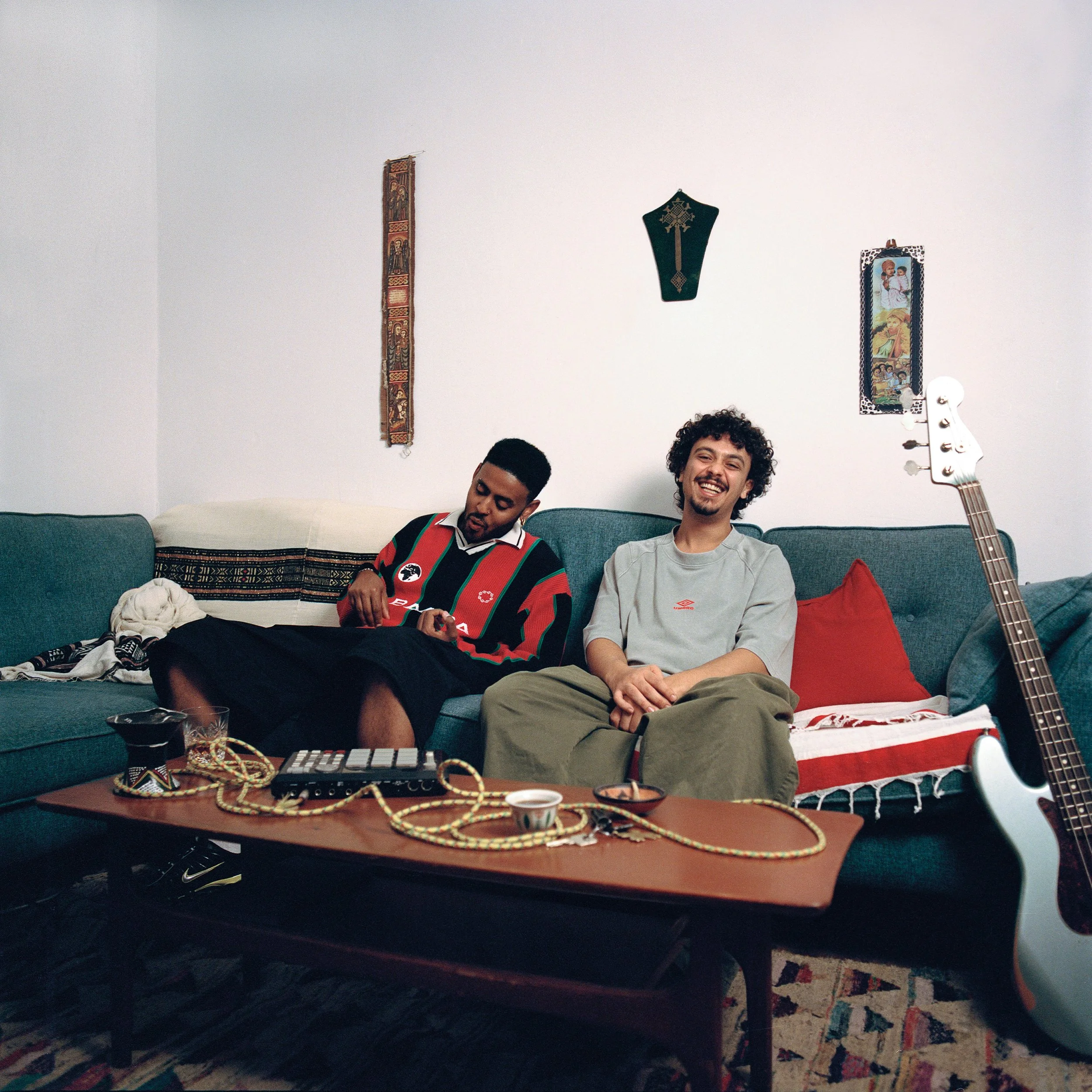
Rooted in Ethiopian musical tradition and shaped by London’s ever evolving sound, the duo Yohan Kebede and Menelik pull from the sounds that filled their homes growing up, stretching them into something modern and built to make you move.
Their debut EP TEMESGEN is a project about gratitude and memory, music that doesn’t rush. We caught up with ZENA to talk about letting improvisation lead, building trust as a duo, bringing Ethiopian musical language into new spaces, and what it means to make “home” a feeling you can hear.
Interview BY VICTORIA ENCONTRA

Q: Take me back to the moment ZENA started to feel real. What was happening around that time?
MENELIK: It was definitely around the time we did our first gig. We were mostly playing covers, but the turnout was so good that we were like, “Oh shit, okay” people actually want to hear the kind of music we want to make. From there, it really gave us confidence.
From the get-go, we always enjoyed making music together and there was a strong creative synergy in the way we worked. Sometimes you can spend hours trying to make music with people and end up with nothing, and other times it’s like, “Oh shit, we accidentally wrote a song.”
Q: ZENA takes influence from Ethiopian heritage but was formed in London. What are some of your earliest memories of Ethiopian music growing up?
YOHAN: My mum used to run a restaurant on Finchley Road in northwest London. Every Friday and Saturday, they’d have live music in the restaurant. There’s a band called Krar Collective, and they used to play every weekend, very traditional music with dancers as well. My whole family worked there too: my mum, my dad, my siblings. I was kind of just roaming around from the age of 6 to 12.
I became really interested in the music, and in between serving people my mum would explain things to me, like what type of Ethiopian music Krar Collective were playing, or how a certain dance came from a specific part of Ethiopia. So when we started making music together, that became my first reference point.
MENELIK: My mum played some traditional music too, but she listened to a lot more Ethiopian funk and jazz, so maybe less Krar Collective and less traditional overall. You could always tell when she was feeling homesick because she’d start playing those records. Most of the time though, it was slightly more modern stuff from the ’70s and ’80s, the music she grew up listening to.

Q: Did you always have that connection to Ethiopian Music?
MENELIK: It always felt normal listening to Ethiopian music. I never felt like I was listening to a separate kind of music. As I got older though, I realised not everyone grows up with that kind of connection, where you’re listening to whatever your parents are playing and seeing them take pride in their music like that. That’s a special thing.
Q: you’ve both mentioned artists like HAILU MERGIA, ALEMAYEHU ESHETE and MULATU ASTATKE. What was it about their music that made you want to create something of your own?
YOHAN: All the artists you just named make us want to create innovative music in the same way they did. They’re all different, but what they have in common is that they took traditional Ethiopian music and interpreted it in their own way.
With Mulatu Astatke, for example, you can hear a lot of Latin American influence in his music. He often blends Ethiopian melodic scales with Latin rhythms. Then you’ve got Hailu Mergia, who plays the accordion and rearranges traditional Ethiopian songs using the organ. Alemayehu Eshete, who they call the “Elvis of Ethiopia”, was heavily inspired by rock and roll.
We want to do the same thing for our generation. MENELIK loves hip hop, and I love hip hop and R&B, so we want to blend those influences with traditional Ethiopian music in the same way Hailu, Alemayehu and Mulatu did in their time.
Q: when you’re creating together in the studio, how does the process usually work between the two of you?
MENELIK: As musicians, we hone our craft when we’re playing live. We try to jam on ideas and sometimes it gets down to that level of detail where we’ll sit for hours talking things through.
In general, I’m probably a bit more laid-back, whereas YOHAN is more thoughtful and says it exactly how it is. He’ll tell you if something feels like too much or too little.

Q: your debut EP TEMSEGEN translates to ‘thank god’ in Amharic. When you listen back to the record now, what moments stand out to you?
YOHAN: The title track, which is called ‘TEMESGEN’, is rooted in a traditional Ethiopian song form called tizita. The easiest way to explain it is that it’s our version of the blues. No one really owns it, everyone just creates their own interpretation of it. Every Ethiopian album will have a tizita somewhere on it. Whether you play saxophone, keyboard or sing, everyone does tizita in some form, so we felt it was only right to do our own version.
Especially when you grow up listening to tizita all the time, once that first section comes in, it really tugs on my heartstrings. That’s probably the best compliment we could give ourselves.
I remember when we were making that song, MENELIK walked into the studio one night and I was sitting there pulling my hair out. He was like, “What’s wrong?” and I said, “I can’t feel it. I’m just not feeling it.” I started calling random Ethiopian people I knew and putting them on loudspeaker like, “Listen to this and tell me honestly if you feel it.” We were playing the track down the phone in the studio and everyone kept saying, “No, no, we feel it.” Eventually, I got there.
MENELIK: The opening track was probably the one we spent the least amount of time on, but weirdly it became the one that stayed with me the most. Every time I sit down to write, I end up replaying the album, and when that track comes on it instantly sets the tone and calms me down. It really grew on me over time. For me, that’s the standout moment.
Q: ‘My Love Your Love’ began through improvisation. Do you remember the moment you realised the track had something special?
MENELIK: I think I remember. We were rehearsing and playing something traditional really, really wrong, to the point where there was no going back. But then we stopped and listened back to the recording and thought, “Oh wait, this bass line is actually cool.”
That song went through so many different stages. It was one of the first tracks we wrote, but it took a long time to finish. Somehow, we managed to build an entire song around that bass line. I remember when we were in the studio recording it properly, and YOHAN was like, “I don’t like the melody, I want to change it.” And I was like, “It’s too late now, man. At least we’ve got the bass line.” For some reason it just felt really catchy.
YOHAN: Because the bass line’s amazing, the drums are amazing. I just felt like my part, the keyboard section, was missing something. My brain is always thinking things could be better, that’s just how I am.
What’s interesting about the song is that it’s built around a traditional Ethiopian rhythm called Eskista. If you’ve ever seen Ethiopian dancing, it’s very shoulder-led and full of movement. Growing up, especially going to Ethiopian clubs and parties, I loved dancing to that music. Beneath the restaurant my family worked in there was a function hall, and when I was younger I even had to go to dancing lessons there.
So when we make a song like that, I need to physically feel it. Even sitting down, I want it to make me feel like I need to get up and move. I remember listening back after we recorded it and thinking, “Oh my God, I really feel this.” I was so happy. At the end of the day, the songs just have to make you feel something.
Q:With TEMESGEN arriving on digital and vinyl via Brownswood, how do you imagine people experiencing this record?
YOHAN: When people listen to ‘TEMESGEN’, I want them to experience Ethiopian music in a way they maybe haven’t before. I think the general perception of Ethiopian music nowadays is that it’s very chilled and reflective, something you sit down and listen to quietly, which is fine. There’s nothing wrong with that view, but I don’t think it should define Ethiopian music as a whole.
For me, Ethiopian music leans much more towards movement and dancing. It’s songs that go on for 15 minutes with the same loop playing over and over while people dance nonstop. There’s alcohol, energy, fun, sensuality, all of that. That’s the feeling we want people to have when they hear the album.
More than anything, this is our experience of Ethiopian music, and we want other people to experience that too.
Q: Is there a type of venue or setting you feel ZENA would love to play in?
MENELIK: I don’t know, honestly I just want to take the music everywhere. There are so many great venues out there.
YOHAN: You know what would be fun? There’s a venue in Brixton called Hootananny Brixton. We’d definitely love to play there, it’s one of my favourite spots.
Next week we’re doing our record launch at a small venue in Dalston. It’s tiny and packed in tight, but it’s run by the funniest Ethiopian guys. My friends actually threw me a birthday party there last week and the owners were drunk the whole night, so I already know the energy would be amazing playing there.
But ultimately, I think we want to play outside the expectations people might have around “cultural” music. I don’t see why this music couldn’t exist at Coachella or somewhere like Soul Action. In my head, anything’s possible.
Q: What’s the weirdest sound you’ve ever tried to build?
MENELIK: We both know there’s a little moment in ‘Anchi Bale Gamé’ where it’s basically just us screaming into a voicemail. He’s going like, “Wooo,” but it’s buried really deep in the mix somewhere.
YOHAN: On our first ever release, which was a cover of ‘Anchi Bale Gamé’, there’s this sound you can hear that goes “woo woo”, and that’s literally just me and him recording ourselves into a voice note. We sent it over to the laptop and dropped it straight into the track.
I think we’re both naturally drawn to weird and quirky sounds in general.
Q: Finish the sentence: people think ZENA is about ______, but really it’s about _____.
YOHAN: People think ZENA is about an Ethio-jazz revival, but really it’s about showing people the sides of Ethiopian music they might not be familiar with, all from the perspective of young Londoners.

QUICK FIRE QUESTIONS
Q: One Ethiopian artist everyone should listen to?
YOHAN: One Ethiopian artist I think everyone should know about is Manalemosh Dibo. She’s honestly one of the greatest singers I’ve ever heard in my life. She’s my favourite Ethiopian artist and I listen to her every single day. Outside of Ethiopia, not many people know her name, but she’s incredible.
MENELIK: Alemayehu Eshete. He’s one of my favourites by far.
Q: A song that reminds you of home?
YOHAN: I’m going to say ‘Gonder’ by Manalemosh Dibo.
MENELIK: It might just have to be a tizita, maybe something by Nati Haile.
Q: Studio session essentials?
YOHAN: Coffee, definitely. Coffee and incense.
MENELIK: You hate lights, so… darkness.
Q: One artist you’d love to collaborate with, current and past?
YOHAN: Current, I’d say Nourished by Time. He’s amazing. He made an album last year called The Passionate Ones, which was probably my favourite album of the year.
For a past artist, I’d say Rod Temperton. He wrote some of Michael Jackson’s greatest records.
MENELIK: Current artists… honestly, I don’t really listen to much current music. But if we’re talking past artists, I would’ve loved to be in those Parliament-Funkadelic sessions in the ’70s. That whole George Clinton era.
Q: What are you listening to right now that’s seeping into your work?
YOHAN: I’ve been listening to A$AP Rocky a lot, especially Don’t Be Dumb. People might wonder how that connects to what we’re doing, but part of our sound is about blending Ethiopian music with everything we listen to now. Sometimes when I hear our album, it feels like parts of it could sit at the beginning of a hip hop record. A$AP Rocky’s production is always incredible, so I’m always thinking about how we can bring some of that energy into what we do.
MENELIK: I’ve been rinsing Slick Rick recently. The Ruler is just too good. We need some of that energy in there too.